Friday, September 5, 2014

Friday, August 15, 2014
The Blind Songbird
Bernadette "Bernah" Navarro, whose native talents were first discovered at the age of three, is a truly promising performer who can inspire and entertain her audience despite her poor eyesight.

When she was born, doctors diagnosed her that she would become totally blind. But her mother had seen a vision in her dream that her child would not live her life totally blind. She sought a doctor for a second opinion and after a series of tests, Bernah's left eye showed signs that it could see, but her right eye will remain blind. A year after, she had a left eye surgery. This spared her from a world of total darkness.
Growing up just like any people with imperfections, she was not exempted from being teased, whether directly or indirectly.
But she proved that she couldn't be let down by winning in singing contests, beating other children who were born without any disability.
Soon, she got enrolled in a special school for the visually impaired where she was treated, respected, and her talents fully recognized, thanks to the sponsorship which came from Monet Silvestre, voice coach and musician, among others.
One of her blind teachers, Mrs. Lopez, has "seen" the artist in her when she heard her sing for the first time, the nationalistic song, "Inang Bayan".

Her passion for music and zeal to perform was highly recognized, opening opportunities for her to sing and dance in big events. Because of this, she was dubbed, The Songbird of Philippine National School for the Blind.
Her dance teacher, Gloria Jamandre, said that aside from doing broadway, Berna could also do ballroom dancing and be a bamboo clapper in Tinikling.

A positive outlook in her life and her creative visualization let her achieve her dreams.
"Mahilig ako sa music at mag-imagine. Sa umaga, ang parati kong ginagawa ay linisin ang kwarto at ini-imagine ko na studio ang kwartong iyon. Tapos, magpapatugtog ako ng music at sumasabay ako sa pagkanta", Bernah said.
Her next step is to pursue an educational scholarship from a foundation so she could enter college and take up a course in Music. She dreamed of teaching music after getting a successful career in musical performance.
Truly, Berna's story is an inspiration for all to be brave in the face of adversity. One's imperfection is not a hindrance to become an achiever.
Friday, July 25, 2014
The Making of a Nipa Cottage
The nipa cottage business of Mrs. Gonzales is currently located in Highway 2000 in Taytay, Rizal but the materials used in making nipa cottages like bamboo usually comes from Baras or Tanay in Rizal, while thatched nipa palm leaves or pawid comes from Pangasinan.
How a Nipa cottage is made:
Four bamboo poles and coco lumber are used to erect the framework of the cottage. Bamboo poles function as pillars while coco lumber is used as joists to support the flooring, sitting area and upper support of the structure. The outer skins of bamboos have to be removed manually by the use of bolo.

Next, bamboo slats are laid over and nailed to the coco lumber joists to serve as the floor and place for sitting.

Wider bamboo slats are nailed and cut with a saw to cover the joists of the upper framework.

Next, the pyramidal roof framework is constructed out of bamboo.
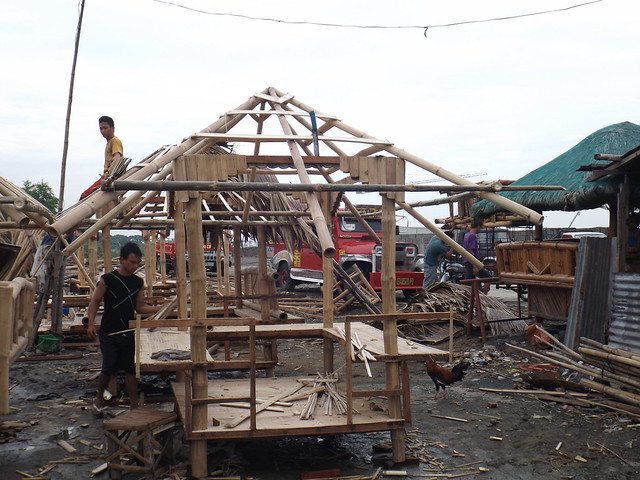
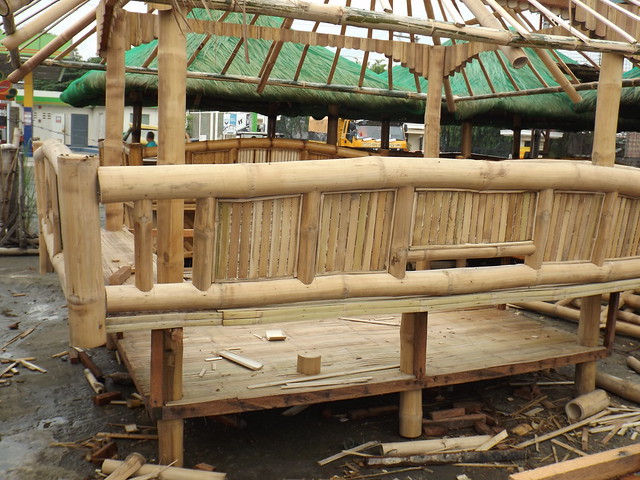
Walls are made by nailing bamboo slats on two long bamboo poles. The bamboo walls are attached between the bamboo pillars of the body framework. The slats are also added to cover the lower part of the structure.

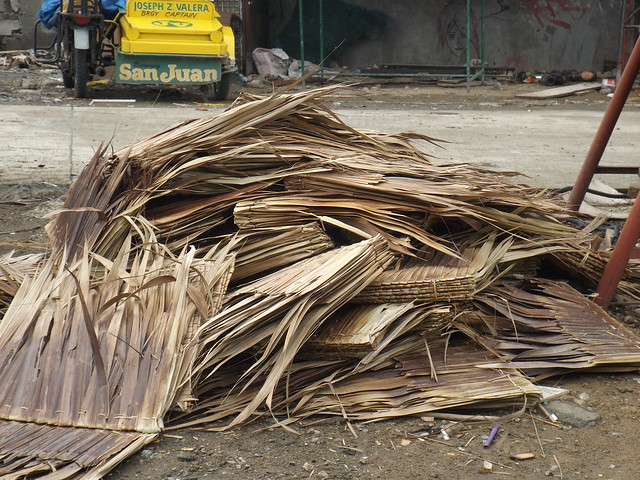
Next, dried Nipa palm thatch panels were laid by overlapping them on the roof framework.

The nipa cottage is now built completely with a door optionally added. A net covers the roof and the black designs are applied by creatively burning some parts of the bamboo. The last step is varnishing.


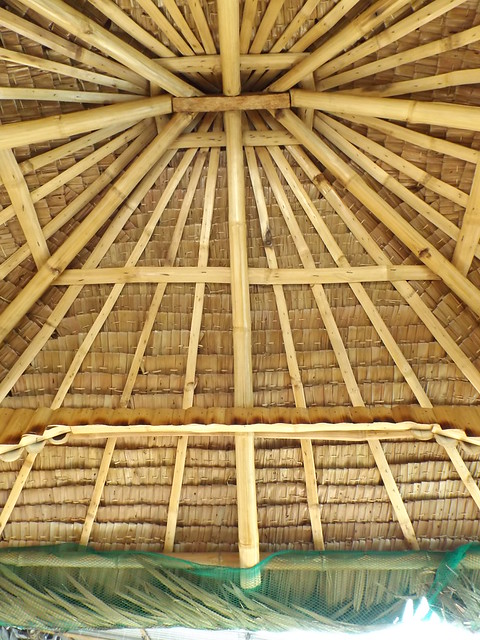
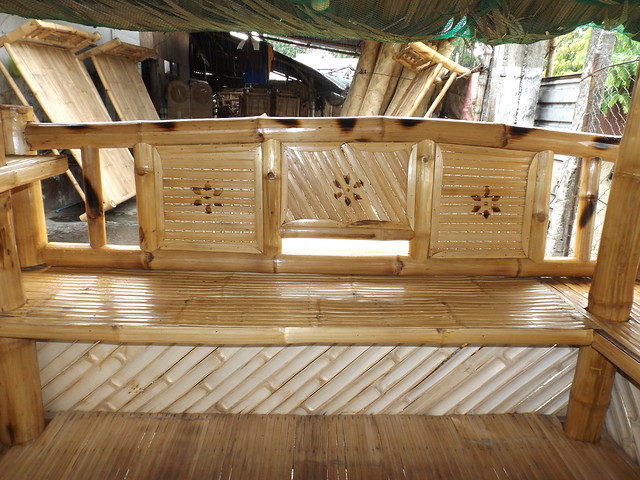
This homey cottage takes a week to build by one or two persons. Ordinary cottages cost from twelve to twenty five thousand pesos while cottages with a room may cost forty to fifty thousand pesos.

Sunday, June 22, 2014
The Philippine Toy Convention of 2014
 I was right. The biggest annual gathering of toy collectors, cosplayers, and J-pop and Anime fanatics happened just recently at Megatrade Halls 1-3 in SM Megamall.


Sunday, June 8, 2014
The Dance of the Nine Maidens
Despite Makati being a modern and highly-urbanized city, it has preserved a tradition that is passed on from generation to generation since the Spanish era - a tradition known as Bailes de los Arcos (Dance of the Arches) or Panatang Sayaw.
Bailes de los Arcos is performed on two consecutive feast days - The Feast of the patron saints Peter and Paul (June 29) and Virgen de la Rosa (June 30) at the plaza of Barangay Poblacion in front of the 17th-century church of Makati.
The dance ritual, which is performed for two hours, has three parts: the diccho or chanting of prayers by each dancer or "mananayaw";


Nine maidens aged 14 years old and above are chosen to be trained as dancers. They must be devotees of Saints Peter and Paul and the Virgin Mary, and can sing high notes.
The most important qualification however, is to be in a state of virginity for the dance is an offering to the Virgen de la Rosa.
Their mothers, grandmothers, and even their grandmothers' mothers were once the virgin dancers.
Devotees strictly choose maidens who wish to be part of the dance.
The old folks of the Poblacion believe that a storm will happen on the day of the feast if one of the dancers lied about being a virgin.
Panata
Some of the dancers dance for several years because it is their "panata".
When a virgin dancer's wish has come true after the "Panatang Sayaw", she may leave the group if she wants to.
The longest-tenured dancer remaining becomes the Capitana or the leader.
The Panatang Sayaw tradition is preserved with the help of the 74-year old Erlinda Atilon-Reyes, a former mananayaw and Capitana. According to her, she taught the dance ritual she learned from her ancestors to the next batches of dancers.
Now that she is getting older and weaker, she still plays some roles in Bailes de los Arcos such as conducting the orchestra.
One of her nieces, Chikee, is this year's Capitana. She has been dancing for seven years.

Chikee has been wishing to earn her college degree at Pamantasan ng Lungsod ng Maynila and become a licensed Chemical Engineer. She's now an incoming 5th year student.
Just like the other dancers, her personal intentions compel her continue her devotion to the patron saints and the Virgin by being a mananayaw.
Witnessing the dance ritual
Enter gray skies. Eight girls dressed in blue and another girl dressed in pink sang songs of prayer and danced while at the center of the stage.
Ladies, young and old, sang simultaneously while watching the ritual. It's amazing that they still have memorized the song despite the long lyrics.
Light drizzles came intermittently but the show went on for two hours. There was no heavy rainfall. A few hours later, they continued to dance on the streets of Barangay Poblacion.
This ritual describes the Filipinos' religiousness and value for culture. Old beliefs are still observed even up to this age of modern technology.
Wednesday, May 21, 2014
Philippine Media Practitioners & CSOs are now skilled in using Open Data
Thanks to the participants of @SchoolOfData Data Skills Training for media & CSOs! Props to teachers @anpe @mexflow pic.twitter.com/5EAOQ7BDLz
— Open Data PH (@datagovph) May 14, 2014Some of the CSO representatives who participated during the workshop were from The Asia Foundation, Asia Society Philippines, PinoyME Foundation, INCITEGov, and Code-NGO. Invited media practitioners represented ABS-CBN, GMA News, GMA News Online, Inquirer, Philstar, Rappler, and Solar News.
Happening now: Media and CSOs team up to explore the @CustomsPH dataset and generate insights #OpenDataPH pic.twitter.com/H49OViXIgK
— Open Data PH (@datagovph) May 17, 2014Ivory Ong of the Department of Budget and Management and Outreach Lead of Open Data PH briefly discussed about the history of the Open Data Taskforce in the Philippines leading to the creation of the National Open Data Portal of the Philippines -- http://www.data.gov.ph "which aims to make national government data searchable, accessible, and useful, with the help of the different agencies of government, and with the participation of the public".
The trainers who conducted the two-day workshop were Anders Pedersen, Knowledge Development Lead of School of Data and Sergio Araiza, a trainer and programmer at Social Tic and Escuela De Datos.
Data driven journalism was discussed on the first day of the workshop. It included topics about planning data investigation and scraping data from websites and pdfs. Through the use of powerful Google-related tools, data from websites such as Philgeps can be downloaded in an easier way, saving time and effort. Data cleaning was also taught, because not all data downloaded were organized. Tables from pdfs can be downloaded using an online tool called Tabula.
@SchoolOfData Data Sherpa @mexflow guiding @solartvnews & @Code_NGO to use @GooglePH Refine #OpenDataPH #opendata pic.twitter.com/lA0zbeJDkk
— Open Data PH (@datagovph) May 17, 2014Another online tool, onlineocr.net, which Solar News Researchers frequently use to convert pdfs to word documents, was also presented but for the purpose of scraping data from pdfs and convert the data to csv file.
Introduction to data visualization was also part of the first day of the workshop. Techniques on how to present timelines through timeline.knightlab.org and playing data through timemapper were also taught. To visualize the data, the output must be published in a website. On the other hand, tools to create maps with emphasis on locating the coordinates were also presented.
How the readers will appreciate the data presented depends on the design of the data visualization. There were so many ways to visualize the data by creating amazing maps through cartodb.com. Most of the tutorials presented can also be found at http://www.schoolofdata.org.
On the second day of the workshop, Open Data PH Chairman Edwin Lacierda was present. Groups were formed and the participants were taught the use of Google Refine in cleaning scraped or downloaded data. In preparation for the Data Expedition, a sample table from the Bureau of Customs was given to each group. The importance of data expedition is for the journalist to ask himself what he needs to get from the data. There are some data that isn't interesting, or not really needed for the story he is going to write or present, and those need to be eliminated. Data expedition also aims at finding interesting new angles for the story.
All groups presented their outputs. The participants were surprised to learn that their were discrepancies in the data published by the BOC. Regardless of the discrepancies, China is still the top exporter of goods to the Philippines. Other groups presented about which countries pay the highest tax for exportation and many others.
The Data Skills Training came to a close after all groups have presented their outputs and Anders Pedersen have invited all participants to join the School of Data Fellowship program. I'm grateful to be part of this rich and comprehensive training.
Today's Data Expedition comes to a close. Thanks to everyone who participated. Job well done, Data Sherpa, @mexflow! pic.twitter.com/9QfEG1pTrA
— Open Data PH (@datagovph) May 17, 2014Thursday, May 15, 2014
Pilgrimage to the River
In one of its remote areas, there is a river called Bitbit. And that was my destination.
The dawn was breaking when my 13-kilometer journey on foot started.
A childhood past was remembered. Fifteen years ago, I climbed the hills with boys. Now that I have grown up, I had four men with me - newfound friends as I could describe them.
Our goal was to reach the river at midmorning. But the steep pathways and zigzag roads made it hard for me to run and catch up with those men, thanks to the burden I carried with me - a bag of unnecessary stuff. The load kept slowing me down. And I became the slowest of them. On of the men paced with me. I felt sorry that he had to wait for me. But we kept on running. Bikers were seen here and there, and I wished I had a bike too.
It was a Sunday morning. I could hear the singing of the choir inside churches we passed by. Children were playing in the streets. I saw some natives cutting wood. Offices and some establishments were closed and there was no way I could leave my stuff. I had to carry it with me for the rest of our journey. There were a lot of dogs madly barking at us, recognizing that we were real foreigners in the area.
We rested at nearby stores. There were convenient areas where we could sit and replenish our lost fluids. The men’s faces were all covered with sweat while their clothes were soaked as if they had plunged into a pool.
As much as we wanted to rest, we had to get going.
Great canopies covered the sides of the road as we moved up. Slowly, the presence of civilization disappeared. The long, long road felt empty. The climb was forever just like the endless blue skies.
I asked myself, “Is it still a thousand miles way from the river?”
My feet sore in the lonely highways. My shoulders ache. One of the men took my "burden" away so I could run faster.
For a few minutes, I have attained a feeling of relief. But this taken pathway was not as easy as I thought. The thought of letting someone carry your cross was heavy on the heart.
Hours later, we reached the dirt road. The dam could be seen from afar. Fogs converge with the forests. And something was calling us.
“Could you hear the gentle whisper of the river?”, one of the men asked.
The story of our destination was gradually unfolding. High emotions continue to fill me. The beating of my heart echoes. The sound is softly inviting us closer to its abode.
Through my eyes I saw the glistening emerald river. I have fallen in love with it. Grand forests served as its ancient guardians. As we crossed the river, dog tracks were seen stamped on them.
Our skins felt the coolness of the river. We bathed in the sun’s light.
I asked the river, “River, did you bring me here?”
It was an auspicious time. I will never forget the day I experienced that ecstasy. In India, pilgrims went to the river Ganges to cleanse their sins. That day, it was like a pilgrimage to release our stress. It was a time of rest after a gruelling long climb. What a lovely Sunday in that emerald sanctuary!
----
Revised version.
First published at worldmomads.com.